
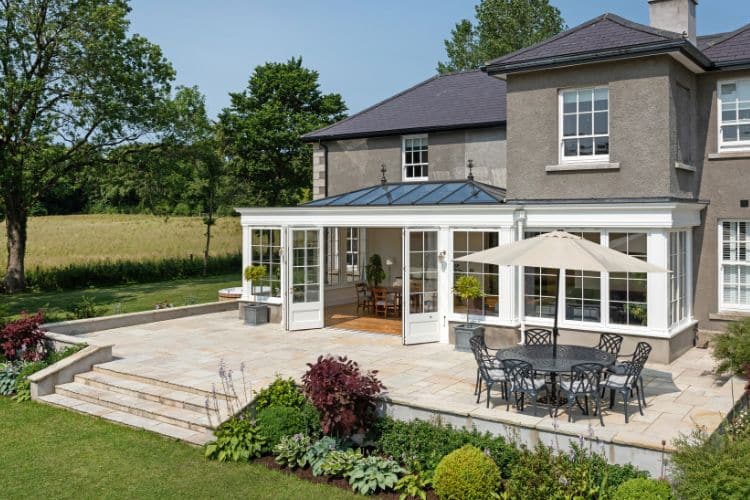
When investing in a home improvement as significant as a bespoke orangery or conservatory, future-thinking homeowners often ask about the impact of a glazed extension on their property’s value.
We spoke with Robin Edwards, a property buying agent at Curetons, who shared his expert perspective on how glazed extensions influence property values, buyer preferences, and saleability in the modern market.
How do you think a glazed extension typically impacts a property’s value?
A well-designed glazed extension, whether that’s an orangery or a high-quality conservatory, can have a very positive impact on both value and saleability of a property, but only when it feels like a natural extension of the house rather than an add-on. In simple terms, buyers pay for space they can genuinely use all year round. A properly insulated, architecturally integrated orangery will almost always add more than its initial cost because it upgrades how the whole ground floor functions and flows.
In value terms, I typically see a strong glazed extension adding at least 5–10% to a property’s price when done well. So if an orangery costs say, 7% of the home’s value, it’s not unrealistic to see an uplift of a similar amount, and often slightly more in prime or design-led markets, because it changes buyer perception of the home rather than just adding square footage.
Do you think there are clear buyer preferences between orangeries, conservatories, and non-glazed extensions?
Buyer preference has shifted quite clearly toward orangeries and general extensions that feel permanent and house-like, rather than traditional conservatories. Orangeries win because they feel warmer, more solid, more architectural and more usable all year round.
Conservatories can still work, but only if they are modern, well-insulated and visually consistent with the main building. If buyers have to think about blinds, heaters, condensation or overheating, they start to mentally downgrade the space immediately.
Can a poorly maintained or outdated conservatory negatively affect a sale?
Absolutely. Buyers often see a poorly maintained or dated conservatory as a future cost rather than a benefit, and yes, they do factor in the price of replacement or removal when making offers. Instead of adding value, it can quietly do the opposite by introducing uncertainty and perceived hassle. I regularly see buyers describe older conservatories as ‘something we’ll have to deal with’ rather than ‘a space we’ll enjoy’.
How do you think a quality extension compares to other home improvements for return on investment?
Compared to other home improvements, a high-quality extension is one of the strongest for perceived return on investment because it combines space, light, lifestyle and flexibility in one move. Kitchens and bathrooms are important, but they refresh what already exists. A great extension actually changes how the house is experienced, which is far more powerful emotionally and financially.
Do you believe buyers notice the difference between bespoke, well-crafted structures and standard installations?
Discerning buyers do notice the difference between bespoke, particularly at higher price points. Materials matter a lot. Timber, aluminium, stone detailing and proper glazing systems signal quality and longevity, while uPVC often signals mass production and shorter lifespan.
At the top end of the market, buyers expect materials that feel architectural, not temporary. The extension should look like it was always part of the house.
Does having an extension designed by a well-known brand help when marketing a property?
If an extension has been completed by a known, respected brand, I would absolutely consider naming it in marketing details, particularly if the buyer demographic values design and craftsmanship. It adds reassurance, credibility and a sense of premium quality. While it doesn’t guarantee a faster sale on its own, it definitely strengthens the story of the house and helps justify the asking price.
Branded items in homes work in a similar way. They don’t automatically make a property sell, but they build confidence. Known appliance manufacturers, glazing systems, designers or architectural features reassure buyers that money has been spent wisely and professionally. It reduces doubt and increases trust, which is incredibly important in the sort of high-value property transactions we deal with.
Has demand for flexible, multi-use spaces increased in recent years?
Massively. Buyers now want rooms that can be a family space, entertaining space, home office and quiet retreats depending on the day. Properties with well-designed extensions almost always generate more interest than similar homes without, because they suggest adaptability and future-proofing. Spaces that feel light, calm and versatile are one of the most powerful selling features a home can have.
Making the right investment
Here at Hampton, we would agree whole-heartedly with Robin’s insights: if you’re going to invest in a glazed extension, it’s worth doing it properly. A well-designed, professionally crafted orangery or conservatory from a reputable company is an investment that can deliver returns both in terms of immediate lifestyle benefits and long-term property value.
Ready to add value to your home?
Our expert team creates extensions that feel like a natural part of your home from day one, ensuring maximum enjoyment for you and your family and maximum value for your property. Contact us today to discuss how a beautifully crafted glazed extension could enhance both your lifestyle and your home’s value.
With thanks to Robin Edwards for sharing his expertise.